.png)
Double Standards in Global Politics: Venezuela, Gaza, and the Test of International Ethics
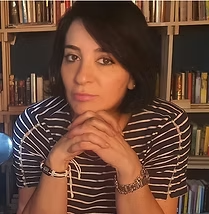
By: Dr. Warda Sada
It is impossible to understand what Venezuela is experiencing today—or the way Nicolás Maduro is portrayed in Western discourse—outside the broader context of global politics built on double standards. The issue is not Maduro as an individual, nor merely the nature of his regime, but the international system itself: how it defines legitimacy, who holds the right to punish, and who is exempt from accountability.
Nicolás Maduro is not a liberal democratic model, and his regime cannot be absolved of real responsibilities: repression of the opposition, concentration of power, and severe economic failures. Yet these characteristics alone do not explain the level of sanctions, siege, and constant threats facing Venezuela. The world is full of regimes that are more authoritarian, less representative, and more repressive, yet they are neither sanctioned nor demonized; rather, they are embraced and supported.
Saudi Arabia, for example, has no national elections and is based on absolute rule, yet it is considered a strategic ally of the United States. Egypt experienced a clear military coup and an almost complete absence of power rotation, yet enjoys consistent political and military support. The United Arab Emirates is a state without pluralistic political life, yet it is presented as a model of “stability and modernity.” Israel practices a long-term occupation and a dual legal system, yet enjoys near-total immunity from international accountability.
What unites these cases?
Not respect for human rights, nor commitment to democracy, but positioning within the Western geopolitical order.
Venezuela, by contrast, stepped outside this alignment. It rejected U.S. hegemony, allied with Washington’s rivals, used its oil outside traditional mechanisms of control, and adopted an explicit position in support of Palestine. Here, authoritarianism becomes intolerable, political failures are transformed into “crimes of universal concern,” and the language of morality is mobilized to justify collective punishment.
The sanctions imposed on Venezuela—like those previously imposed on Cuba—do not primarily target ruling elites as much as they strike society as a whole: health, food, currency, and migration. Yet it is said that “the regime has failed,” as if the blockade were a neutral factor unrelated to collapse. This is a stark moral paradox: pain is produced politically and then used as evidence to condemn the victim.
This logic is not new.
In Chile, the United States supported Pinochet’s bloody coup because it overthrew an elected government that had deviated from the American economic and political line.
In South Africa, Western support for the apartheid regime continued for many years, until its persistence became a moral burden that could no longer be justified.
In Cuba, a long-standing blockade was imposed in the name of freedom, but it produced not democracy, only isolation and suffering—and it continues despite changes in the world.
In all these cases, the criterion was not moral but functional: does the existing regime serve the balance of power, or does it threaten it?
Here the path of Venezuela intersects with that of Gaza, despite differences in geography and context. In Gaza, an entire people is punished under the banner of “security.” In Venezuela, an entire people is punished under the banner of “democracy.” The language differs, but the logic is the same: turning human beings into instruments of pressure rather than values in and of themselves.
International law, in theory, rejects collective punishment, condemns occupation, and protects sovereignty. In practice, however, it is applied selectively—not because it has failed, but because it has been emptied of the principle of equality. Legitimacy no longer derives from law, but from power. And whoever holds power holds the right to define what is moral, what is legitimate, and what constitutes “self-defense.”
Defending Venezuela, or Gaza, does not mean absolving regimes or justifying every policy. It means rejecting one dangerous logic: measuring human dignity by political standards, and granting or withdrawing rights according to a state’s position on the map of influence.
This contradiction becomes even more blatant when we look at the actual practices behind the declared rhetoric. While sanctions on Venezuela are justified in the name of democracy and human rights, American media reports have revealed that the Trump administration recently communicated with U.S. oil companies whose assets were expropriated in Venezuela decades ago, encouraging them to invest heavily in the country if they wished to recover those assets. This fact is not presented as “proof of guilt” in itself, but as a revealing indicator: when the doors of oil investment open, the language of isolation and punishment suddenly recedes, and the crisis is redefined as an “economic opportunity.” Here, the fragility of the moral discourse is laid bare, and oil once again advances as a decisive factor in shaping policy—not as an economic detail, but as a practical criterion of legitimacy.
In a world that claims to defend values, the moral question remains open:
Is the human being an unconditional value?
Or merely a detail in the game of nations?
This question—more than Maduro alone—is what international politics fears today.


