.png)
On Mohammad Bakri, who sought to bring Jews and Arabs closer in a state that persecuted him as an Arab artist who touched its wound in Jenin
- Tamim Abu Khait
- 25 בדצמ׳ 2025
- זמן קריאה 3 דקות
By: Tamim Abu Khait
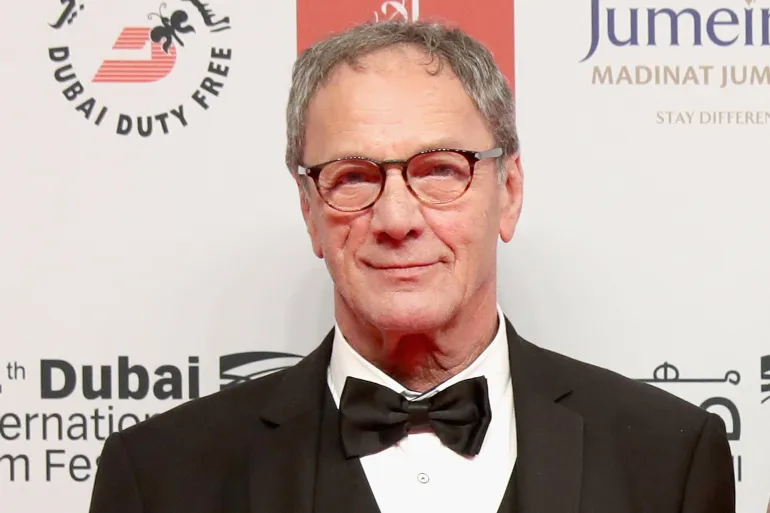
Mohammad Bakri—the artist, actor, director, and politician—passed away yesterday in the village of Bi‘ina in the Galilee, after heart disease overcame him, even though the official Israeli machinery of repression and discrimination never succeeded in breaking him.
Those who wanted his art not to convey the painful and bitter truth pursued him, and pursued one of his films for nearly twenty years until it was banned—blatantly trampling the principles of democracy, freedom of expression, and the sanctity of art that tells the truth.
Bakri died at the age of 72 after a heart illness. He was married to Laila, lived in Bi‘ina, and was the father of six children. Three of his sons—Saleh, Adam, and Ziad—are actors.
Bakri began his acting career at the Haifa Theatre. In 1984 he played the lead role in the film On a Clear Day You Can See Damascus, directed by Eran Riklis, and in the film Behind Bars (written by Eran Price and directed by Uri Barbash), which follows the united struggle of Jewish and Arab prisoners against the prison administration.
In 1987 he participated in the series Ashkara, a drama series intended to bring Jews and Arabs closer together, produced by Israeli Educational Television. Over the course of his career, he appeared in dozens of films and produced dozens of local, international, and even Hollywood productions.
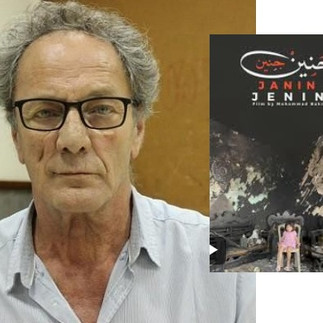
In 2003 he created his film Jenin, Jenin, made in the wake of the Israeli army’s invasion of the Jenin refugee camp, the destruction of large parts of it, fierce battles on the one hand, and the brutal killing of civilians on the other. The film became an early example of what has unfolded over the past two years in Gaza. It was produced largely inside the refugee camp, using live testimonies, during the Second Intifada, a period marked by suicide bombings. The film sparked protests against it inside Israel. It was initially banned by the Film Review Board, but following Bakri’s petition to the High Court of Justice, it was permitted for screening. Bakri was later sued in a civil defamation case by soldiers who took part in the Jenin operation and accused him of libel. In January 2021, the district court prohibited the distribution and screening of the film and ordered the confiscation of its copies. Nevertheless, Bakri took the film to many international festivals around the world, where it won several prestigious awards. In one of his films, he portrayed a Jew in a concentration camp.
Bakri was involved in political life throughout his life. He was active in the Israeli Communist Party and in Hadash. A significant portion of Bakri’s work addresses the Israeli–Palestinian conflict. In 2015 he ran for a place on Hadash’s list ahead of the twentieth Knesset elections.
I will conclude with a few quotations written about him:
Uri Barbash, who directed Behind Bars, in which Mohammad Bakri won prestigious awards for his performance, said that had Mohammad Bakri not insisted on remaining in his hometown of Bi‘ina, he would have been among the leading stars of world cinema.
Amit Attias wrote about him yesterday:“Being Mohammad Bakri in Israel of recent years is like a life sentence with hard labor. His heart could not endure it.”“He did not seek consensus, nor applause. Actor and director Mohammad Bakri chose a path of continuous confrontation with the establishment, public opinion, and the boundaries of freedom of expression in Israel. Creators who worked with him over the years bid farewell to a man who paid a heavy price for his struggle: ‘He always said—You are mistaken in thinking that I hate the state. I only want it to be better for people like me.’”
Michael Sfard wrote:“Israeliness embraced Mohammad Bakri as long as he was perceived as an actor who is Arab, but violently rejected him the moment it realized he was an actor—full stop. Even so, the Palestinian who portrayed a Jew in a concentration camp refused to break and remained the beautiful humanist he was until his last day.”
May his memory be a blessing.
Here is the link to the full article in Local Call: